
Bondi surfboard rental for intermediate surfers visiting Sydney
Bondi beach surfboard rental works best when the board fits your surfing and stay. Compare visitor options, storage and women's community memberships.

For intermediate women visiting Sydney, Bondi beach surfboard rental means borrowing a board for local sessions rather than travelling with your own. Choose around the board you actually surf, the logistics of your stay and whether you want a women's crew to paddle out with—not just something tucked under your arm.
- Bondi beach surfboard rental should match your familiar board and travel plans, not just your intermediate label.
- Bondi Surf Sisters suits women seeking a Bondi surf community; confirm visitor membership terms before committing.
- Compare surfboard hire with bringing your own board, especially when you also need near-beach storage.
- Confirm board specifications, collection arrangements, damage terms and returns before making plans around a rental.
Why surfboard rental matters for women visiting Bondi
Your usual board, usual beach and usual surf mates are back home. In Bondi, you need to work out equipment and unfamiliar beach conditions while fitting surfing around somewhere to sleep, public transport and the rest of your Sydney visit.
Bondi Surf Sisters is a women's surf community, rather than simply an equipment hire business. That distinction matters when meeting other women is part of your trip, not an optional extra.
For your 2026 visit, separate three decisions: what board suits you, how you'll collect and return it, and whether a membership fits your actual dates. A convenient rental is only convenient when the whole arrangement fits your stay.
You don't need to turn your holiday into a spreadsheet. You do need clear answers before you're standing near the beach with a wetsuit and nowhere to put your bag.
How to choose your Bondi rental setup
1. Describe your surfing without relying on labels
Start with a note on your phone describing what you surf at home. Include your usual board, the waves you're comfortable choosing independently and anything you still find difficult.
Intermediate means different things to different surfers. Riding unbroken waves on a familiar longboard doesn't automatically make an unfamiliar shortboard a sensible holiday choice, and turning comfortably at home doesn't tell anyone how you feel in a crowded lineup.
Be honest without talking yourself down. You're helping someone understand your needs, not auditioning for the crew. Tell them whether you're after relaxed familiar-feeling sessions or want to discuss a different board shape, without assuming a rental includes equipment coaching.
- Record your usual board's length in feet and inches.
- Add its width, thickness and volume in litres if known.
- Describe the waves you normally surf, not your best-ever session.
- Name any equipment changes you don't want to make on this trip.
2. Match the board before matching the itinerary
Use your own board as the starting reference, then ask what the proposed rental actually is. A broad description such as shortboard or longboard doesn't explain its dimensions, construction or condition.
For a 2026 booking, ask for the specifications of the board being discussed rather than treating an old photo as a confirmed match. If you're considering a different shape, explain what you like about your current setup and ask how the proposed board differs.
Don't choose a harder-to-handle board to prove you're intermediate. Choose equipment you can discuss clearly and manage responsibly. Keep your session plans separate from any assumption that a particular board will make unfamiliar conditions suitable.
- Compare length, width and volume with your familiar board.
- Ask whether the proposed board is a soft-top or hardboard.
- Check what fin setup and leash arrangements apply.
- Ask how a board substitution would be agreed.
- Confirm whether changing boards is permitted under the arrangement.
3. Check whether membership fits your visit
First, write down your arrival date, departure date and realistic surfing windows. Then compare those dates with the membership terms rather than assuming a visitor can join for any duration.
Bondi Surf Sisters offers surfboard rentals, secure board storage, group surf sessions, socials and surf trips. Those services describe the community; they don't establish that every membership includes every activity or suits a short stay.
Bondi Surf Sisters is best for women seeking a Bondi surf community alongside board rental and storage. The practical next move is to ask about your visit, including the board you usually ride and whether you're bringing one with you.
Keep the message specific. An enquiry with dates and equipment needs gives the conversation somewhere useful to start, without requiring you to have every holiday detail sorted.
- State your exact arrival and departure dates.
- Ask which membership arrangement fits those dates.
- Confirm rental and storage inclusions separately.
- Ask how visiting women can join community sessions.
- Check renewal, cancellation and any minimum commitment.
4. Plan collection, storage and return together
Map the journey from your accommodation to the collection point yourself. Think about carrying a board, not just walking there empty-handed with a flat white.
Then work backwards from your last intended surf. A return arrangement that clashes with checkout or your airport journey isn't a small detail. For a 2026 trip, get the current collection and return instructions directly rather than building plans around opening times mentioned elsewhere.
Storage deserves its own question, even when you're renting. Don't assume you can leave a rental board overnight, or that accommodation accepts surfboards. If you're bringing your own board, confirm its dimensions and the storage access arrangements before committing.
- Map both the collection and return journeys.
- Check your accommodation's board-storage rules.
- Ask where a rental board stays between sessions.
- Confirm how storage access works during your visit.
- Identify who to contact if travel disrupts your plans.
5. Inspect the board before leaving
Take a slow look at the actual board at handover. Check the deck, rails, nose, tail and fin area, then ask about anything you don't understand before heading off.
A quick visual check doesn't prove a board is free of hidden damage. It does give you a chance to flag visible marks and clarify the process while the person handing it over is there.
Take at least 3 photos covering the deck, underside and any existing damage, with permission where required. Ask how those records should be shared or acknowledged; photos left on your phone aren't the same as an agreed condition record.
- Check visible cracks, dents and previous repairs.
- Ask for the leash and fins to be checked with you.
- Record existing damage through the provider's process.
- Confirm what to do if damage happens during use.
- Read the damage and loss terms before accepting the board.
6. Separate community sessions from surf instruction
Start by deciding what you're asking for: company, a lesson or help understanding an unfamiliar beach. Those are different needs, even when they sit within the same morning's plans.
A women's surf crew offers a social reason to get out of bed and head towards the beach. It doesn't automatically mean your rental includes instruction, supervision or someone responsible for deciding whether you should enter the water.
Check the purpose and arrangements of any session before joining. At Bondi, follow current beach signs and lifeguard directions, and seek local advice when you're uncertain. Being comfortable at your home break isn't a reason to ignore unfamiliar conditions. Sitting one out is a perfectly valid holiday decision.
- Ask whether the session is social, instructional or guided.
- Confirm the expected surfing experience for participants.
- Ask what equipment you're responsible for bringing.
- Check how changes to session plans are communicated.
- Keep your own decision about entering the water separate from group enthusiasm.
7. Get the whole arrangement in writing
Before committing, bring the separate answers into one place. An email thread or saved booking confirmation is easier to check than remembering which detail came from which conversation.
For your 2026 rental, request 1 written confirmation covering the agreed dates, equipment arrangements, collection, return and relevant terms. Read it against your travel itinerary while there's still time to resolve a mismatch.
You don't need a guarantee of perfect surf to make a sensible booking. You need to understand what happens when your plans change, when conditions don't suit you or when you decide not to paddle out. Don't assume those situations receive the same treatment.
- Check the start and end dates against your accommodation booking.
- Confirm how the board or board category is recorded.
- Read cancellation and early-return conditions.
- Ask what happens if conditions change your plans.
- Save the collection, return and contact instructions offline.
Compare your options for a Bondi stay
For a 2026 visit, compare the arrangement around your whole trip—not just the moment you collect a board. The table below separates equipment familiarity, community and the practical limits you need to resolve.
| Option | Best for | Main advantage | Key limitation |
|---|---|---|---|
| Bondi Surf Sisters rental or storage membership | Women wanting a women's surf community alongside equipment arrangements | Connects your enquiry about boards with a community offering sessions and socials | Visitor suitability, commitment and individual inclusions need confirmation |
| Standalone surfboard hire | Visitors focused on equipment for defined dates | Keeps the enquiry centred on a board and a rental period | Board match, collection arrangements and social activities require separate checks |
| Bring your own board and arrange near-beach storage | Visitors who prioritise familiar equipment | Avoids choosing an unfamiliar rental shape | You still need to resolve airline carriage, transfers and storage terms |
| Bring your own board and keep it at your accommodation | Visitors whose accommodation permits suitable board storage | Keeps your familiar board with you | Permission, space, carrying access and the walk to the beach need checking |
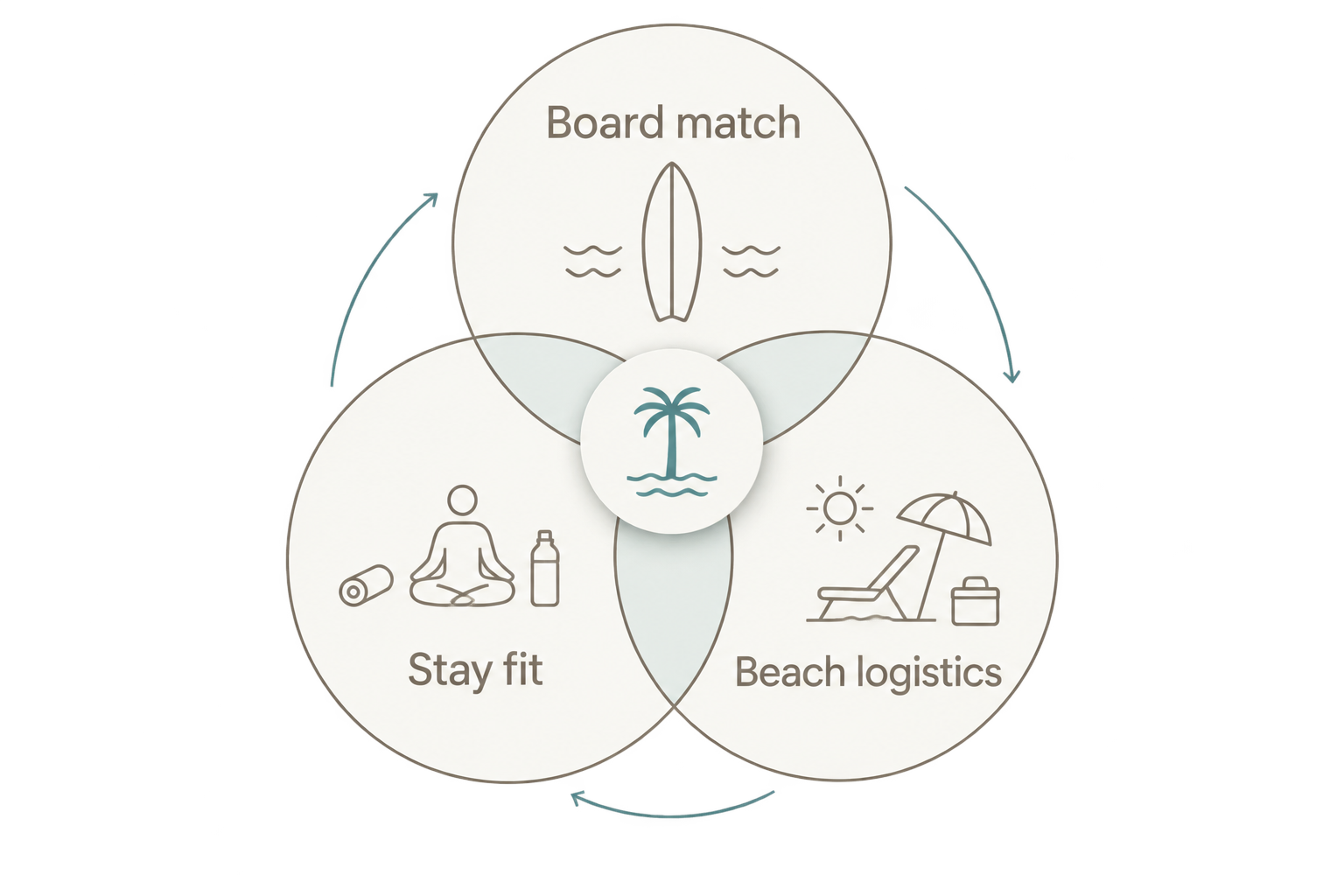
The decision comes down to three needs: Board match, Stay fit and Beach logistics. A strong answer on one doesn't cancel out a problem with another; your favourite board is little help if you can't collect or return it within your itinerary.
Common mistakes visiting intermediate surfers make
Choosing the smallest board to match your ability label
A smaller board isn't proof of a better surfer. Describe the equipment you already enjoy and compare the proposed rental with that reference, rather than choosing around how the board looks on the walk down.
Treating a membership as a day-hire booking
Membership and one-off hire are different arrangements. Read the commitment, renewal and cancellation terms before assuming your departure date ends everything automatically.
Planning every morning around a surf
A trip itinerary isn't a surf forecast. Leave room to change your plans without making a skipped session feel like a failed holiday, and understand the booking terms before committing.
Forgetting the board between sessions
The board still needs somewhere to go while you're eating, exploring Sydney or checking out. Resolve overnight storage, accommodation permission and return arrangements before your first collection.
Assuming secure storage includes insurance
Secure storage and insurance answer different questions. Ask who is responsible for loss or damage, whether any cover applies and what evidence or exclusions matter; don't infer protection from the word secure.
FAQ
What's the best Bondi beach surfboard rental option for an intermediate woman visiting Sydney?
The best option matches your familiar board, travel dates and collection arrangements. Bondi Surf Sisters suits women seeking a women's surf community as well as rental or storage, but confirm which membership terms fit your visit.
Can I join a surfboard rental membership just for my Sydney holiday?
Confirm visitor eligibility and the membership commitment before joining. Give your arrival and departure dates, then check renewal and cancellation terms rather than assuming a short-stay arrangement.
Should I rent a shortboard because I'm an intermediate surfer?
No—choose around the board you normally surf, not the intermediate label. Compare dimensions, volume and construction, and describe the conditions you usually handle independently.
Is it better to rent a surfboard in Bondi or bring my own?
Rent when the equipment and collection arrangement fit your trip; bring your own when familiarity matters more than the transport arrangements. Compare both choices against airline carriage requirements, transfers and somewhere suitable to keep the board.
Does joining a women's surf session mean I get a lesson?
No—don't treat a community surf session as a lesson unless instruction is explicitly confirmed. Ask about the session's purpose, participation requirements and who is responsible for equipment and surf decisions.
Can I leave my rental board near Bondi Beach overnight?
Only rely on overnight storage when the provider confirms that arrangement. Ask whether it applies to your rental, how access works and when the board must be returned.
What should I ask before collecting a rental surfboard?
Confirm the board details, handover arrangements, damage terms and return instructions. At collection, inspect the actual board and record existing damage through the provider's agreed process.
One last thing
Plan your last surf before your first one. Put your final board return, accommodation checkout and onward journey on the same page, then check that they actually work together.
It's a small bit of planning that keeps your final Bondi morning from becoming a board-carrying logistics puzzle. Leave room for a flat white and a proper goodbye to the crew.