Soft top or hardboard: choosing your Bondi rental board
For Bondi Beach surfboard rental, start with a soft top if you’re learning. Compare hardboards, board fit and visitor membership checks before you book.
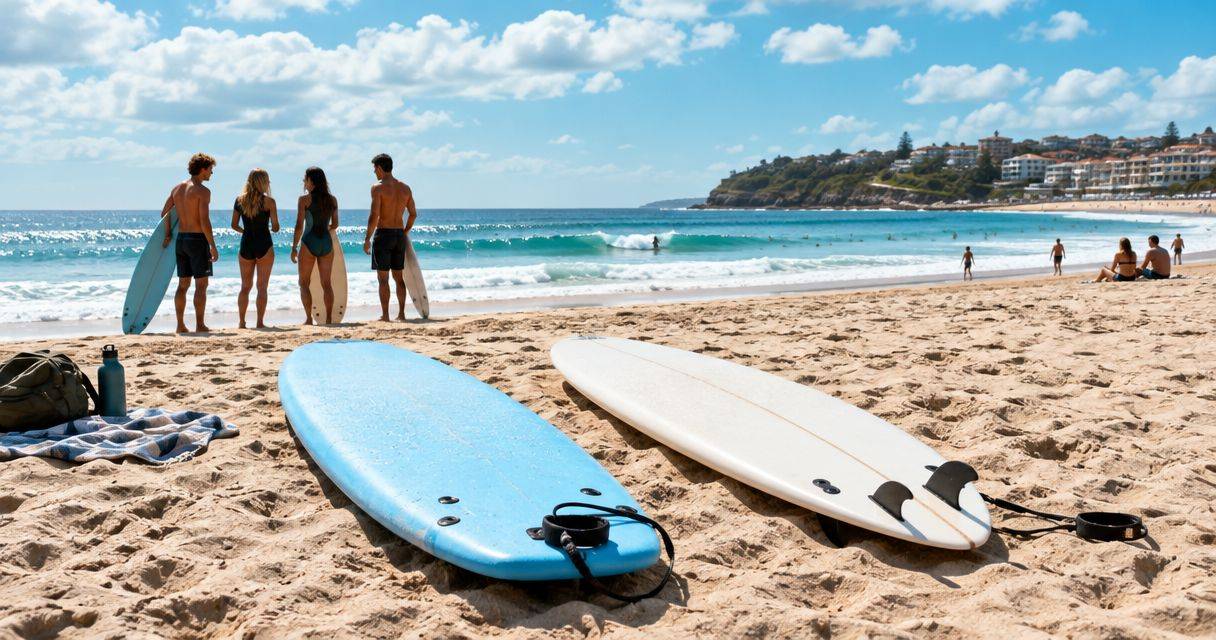
Choose a soft top for your Bondi Beach surfboard rental if you’re learning, returning after a break or want a softer deck; choose a hardboard if you already catch waves independently and know the board shape you want. For your 2026 visit, match the board’s dimensions and condition to your surfing, then check the rental terms separately: construction alone doesn’t tell you whether a board fits you or your stay.
- For bondi beach surfboard rental, choose a soft top when learning; choose a hardboard when its shape suits your surfing.
- Board dimensions matter alongside construction: a soft top is not automatically the easier board.
- Bondi Surf Sisters offers women’s surf community membership, surfboard rental and secure board storage.
- Check visitor membership terms, collection arrangements and damage responsibilities before committing.
Soft top or hardboard: which Bondi rental board should you choose?
Start with what you can comfortably do in the water, not what you hope to do by the end of the trip. If you’re still practising paddling, catching broken waves and standing up, a suitably sized soft top is the sensible starting point. If you can catch unbroken waves independently, turn deliberately and control your board, consider a hardboard that matches your experience.
Neither label settles the decision on its own. A short, narrow soft top and a long, wide soft top are different boards to surf, despite sharing a construction category.
| Board option | Best for | Main advantage | Main limitation |
|---|---|---|---|
| Soft top | Learners, returning surfers and women who prefer a softer deck | Cushioned deck contact while you practise | The soft-top label doesn’t guarantee suitable dimensions or easy handling |
| Hardboard | Independent surfers who know their preferred shape | A firmer construction with a more direct feel | The harder surface is less forgiving during contact; an unsuitable shape still makes surfing difficult |
Bondi Surf Sisters brings surfboard rental and secure storage together with a women’s surf community. Check which membership arrangement fits your visit before building your holiday plans around it.
Why this matters when you’re visiting Bondi
Your holiday board needs to fit the surf you can manage and the practicalities of your stay. A board that feels familiar underfoot is less useful if you haven’t worked out collection, return or where it goes overnight.
For a 2026 Bondi visit, sort the board choice and rental arrangement together. That means asking about the actual board, not simply requesting a soft top or hardboard and assuming everything else follows.
You also don’t need to choose a harder board to prove you belong in the lineup. Pick equipment that supports the session you’re ready for. There’s no prize for making your paddle-out harder than it needs to be.
Soft top: best for learning and getting reacquainted
A soft top has a cushioned deck rather than an exposed hard outer surface. That softer contact is useful when you’re spending time lying down, getting to your knees and practising the movement to your feet.
Choose a soft top when your priority is settling into the basics rather than chasing a particular board response. Tell the rental provider what you’ve actually surfed before, including whether you were catching waves yourself or being helped into them.
Be clear about the distinction between a lesson and an independent rental. Having stood up during a coached session doesn’t establish that you can select waves, control the board and manage a busy surf area alone.
The benefit
A suitable soft top lets you focus on familiar movements without choosing a board purely for its appearance. The cushioned deck also gives you a softer surface to lie and kneel on.
The trade-off
Soft construction does not make every board stable, buoyant enough for you or appropriate for the conditions. Fins, the underside and the board itself still need careful handling around other people.
Ask about length, width and overall shape. If the answer is only that it’s a beginner board, keep asking until you understand why that particular board suits your experience.
Hardboard: best for surfers who know their preferred shape
A hardboard has a rigid outer shell, commonly made with fibreglass and resin over a foam core. Surfers who already know the shapes they enjoy can use that experience to make a more specific rental request.
Choose a hardboard because its shape suits your surfing, not because it sounds like the next level. A longer hardboard and a short performance shape demand different things from you; the construction name doesn’t describe the whole ride.
If you normally surf a particular style of board, explain its approximate dimensions and what you like about it. Describe how it paddles and turns rather than relying on a brand name the rental provider might not carry.
The benefit
A suitable hardboard can give an experienced surfer the firmer, more direct feel they already prefer. Familiarity with that style of board gives you a useful basis for choosing.
The trade-off
The rigid surface is less forgiving during contact, and damage needs attention. A hardboard is also not automatically lighter, easier to paddle or better suited to the day than a soft top.
Before accepting a rental, check the deck, rails, nose, tail and fins with the provider. Point out existing damage and follow the provider’s instructions if anything changes during your rental.
How to choose your rental board before you commit
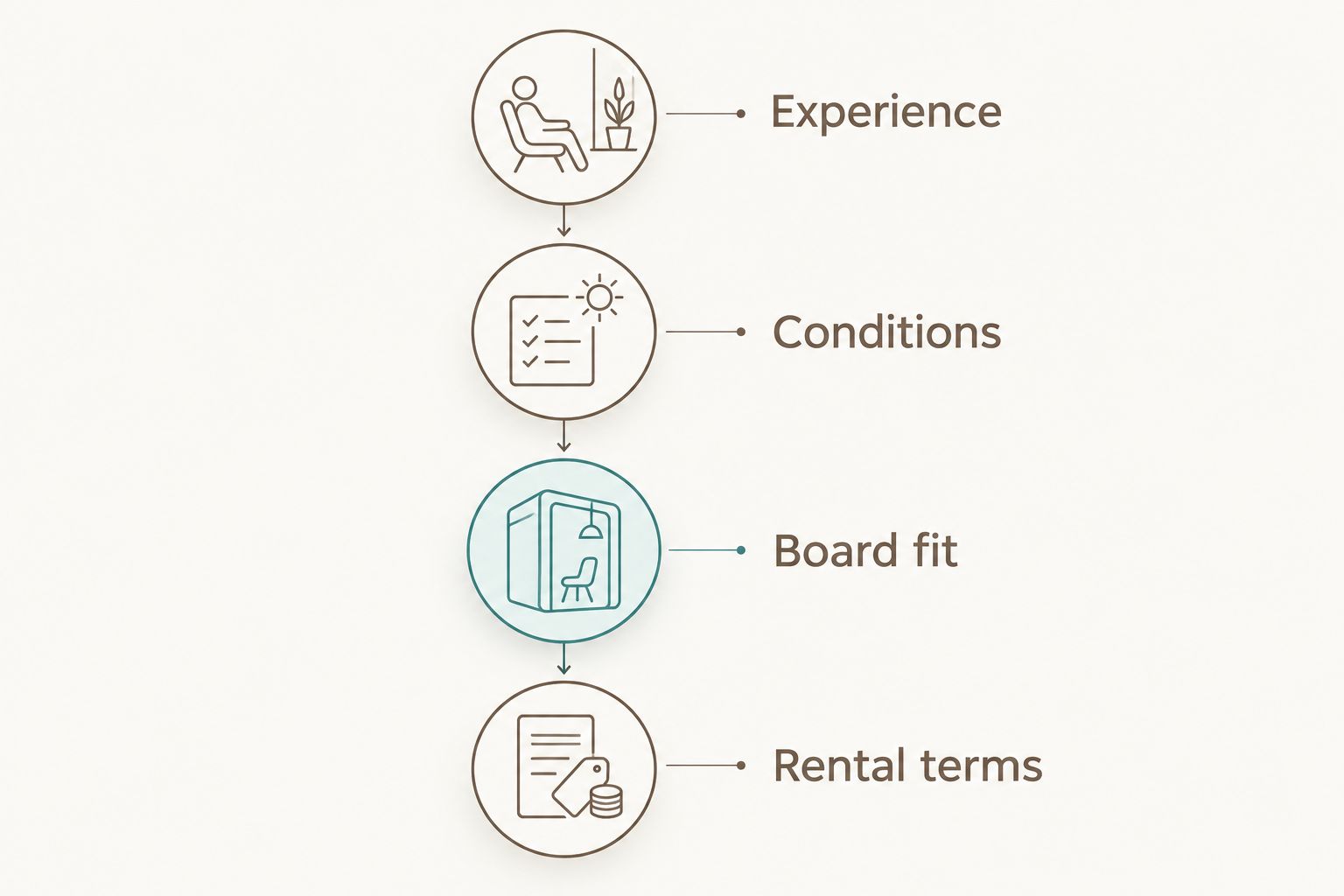
Use this sequence for your 2026 rental enquiry. It keeps the conversation focused on what you need rather than whether one board category sounds more impressive.
- Experience. Describe your recent surfing honestly. Say whether you catch waves independently, where you usually surf and what board you last used. Mention a long break rather than treating old experience as current practice.
- Conditions. Ask whether the proposed board suits your ability in the conditions expected for your session. Check again on the day; a booking is not a reason to paddle out when the surf is beyond you.
- Board fit. Ask about the actual board’s dimensions and shape. Confirm that you can carry and control it, and explain any equipment preferences that already work for you.
- Rental terms. Confirm how membership applies to visitors, how collection and return work, what equipment is included and what happens if the board is damaged. Get the details before making plans around access.
The best answer is specific to you and the proposed board. A general assurance that everyone uses the same sort of board doesn’t replace a discussion about your experience and plans.
What to say when you enquire
Try a straightforward description: explain how recently you surfed, whether you caught waves without help and what sort of board you used. Then describe the dates of your visit and whether you need somewhere to keep a board near the beach.
You don’t need surf-shop vocabulary to ask useful questions. Saying you felt unsteady while paddling, struggled to catch waves or found a board awkward to carry gives the provider something practical to work with.
If you don’t know a previous board’s dimensions, say so. A clear account of your experience is more useful than guessing a size and accidentally asking for something unsuitable.
Why your Bondi rental board choice varies
There isn’t a universal soft-top-versus-hardboard answer for every visiting surfer. These factors change what makes sense:
- Recent experience. Regular independent surfing gives you a different starting point from occasional lessons or returning after a break. Describe what you can do now.
- Board dimensions. Length, width, thickness and shape affect paddling, stability and turning. Construction is only part of the picture.
- Conditions on the day. Wave size, currents, wind and crowding affect whether a session suits you. Neither board category removes the need to assess the beach.
- Your transport plan. Carrying a board between accommodation and the beach is part of the rental decision. Think through the route before choosing equipment.
- Your storage plan. If you’re using your own board, or need to keep a rental between sessions, establish where it can stay and whether a storage arrangement covers your needs.
- The rental agreement. Visitor eligibility, access arrangements, equipment inclusions and damage responsibilities need checking directly. Don’t infer short-stay terms from the word membership.
Separate equipment suitability from convenience. A board can suit your surfing while the access arrangement doesn’t suit your trip, or the other way round.
Is a soft top always better for a beginner at Bondi?
A suitably sized soft top is a sensible starting point for a beginner, but the label alone is not enough. Ask why the particular board suits your size and experience, and don’t treat equipment hire as a substitute for instruction when you still need help managing yourself and the board.
Should you rent the same board you surf at home?
A familiar board style is a useful starting point if you already surf independently. Describe its dimensions and handling, then discuss whether a similar shape suits the conditions rather than insisting on an exact match regardless of the day.
Should you organise storage if you’re only visiting Bondi?
Storage deserves a place in your plan whenever carrying or keeping a board complicates your stay. Ask whether the membership terms suit visitors and whether storage applies to your own board, a rental board or both; don’t assume those arrangements are interchangeable.
A women’s crew, not just a board handover
Bondi Surf Sisters is best for women seeking a Bondi surf community alongside surfboard rental and storage. The community also offers group surf sessions, socials and surf trips, so the conversation can be about belonging as well as equipment.
That distinction matters when you’re visiting without your usual surf mates. You can ask about the community and the board arrangement together, without assuming a particular session, social or trip forms part of your rental membership.
For your 2026 plans, confirm what the relevant membership includes and whether its terms fit your stay. A community membership is not automatically the same arrangement as a casual board hire, and neither should be booked on assumptions.
Come as you are, with an honest description of your surfing. There’s no need to arrive with the right jargon or pretend you’ve been paddling out every morning.
Ask about your Bondi board plans
Check visitor membership terms, board suitability and storage arrangements for your stay.
FAQ
What’s the best board for my first Bondi Beach surfboard rental?
A suitably sized soft top is a sensible starting point if you’re learning. Discuss your experience and the actual board dimensions, and arrange instruction if you still need help catching waves or controlling the board.
Is a hardboard better than a soft top?
A hardboard is not universally better than a soft top. Choose a hardboard when its shape and firmer feel suit your existing surfing; choose a soft top when you prefer a cushioned deck and an appropriate learning-oriented shape.
Can I rent a board if I’ve only had a surf lesson?
A previous lesson does not by itself establish that independent rental suits you. Explain what you could do without help and ask whether further instruction is the more appropriate next step.
Does Bondi Surf Sisters offer board rental and storage?
Bondi Surf Sisters offers surfboard rental and secure board storage as part of its women’s surf community offering. Confirm the relevant membership terms, visitor suitability and inclusions before planning your stay around them.
Do I need a car to organise a surfboard in Bondi?
Your transport needs depend on the collection arrangement, your accommodation and where the board will stay. Confirm those details rather than assuming delivery, beachside collection or overnight storage is included.
What should I check before taking a rental surfboard?
Check the board’s condition, suitability and rental agreement before accepting it. Point out existing damage, confirm the included equipment and understand collection, return and damage responsibilities.
Should I book a hardboard for bigger waves?
Bigger waves are not a reason on their own to switch to a hardboard. Choose conditions within your ability and discuss the actual board shape; changing construction does not make an unsuitable session appropriate.
One last thing
Ask yourself whether you’d choose the same board if nobody else could see it. If the answer changes, you’ve probably found the least useful part of the decision.
For a 2026 Bondi trip, put familiarity, suitable dimensions and clear arrangements ahead of appearances. Bondi Surf Sisters offers a place to ask about boards and community together; check the membership details, then decide whether the arrangement fits your visit. Salty hair is optional. Pretending to be more experienced than you are isn’t required.