
Does surfboard storage include insurance for your board?
Surfboard storage does not confirm insurance cover. Check theft, damage, exclusions and your own policy before leaving your board near Bondi Beach.

Surfboard storage does not, by itself, confirm that your board is insured: you need written terms showing whether cover applies to your board and the circumstances of a claim. Secure storage and insurance are separate things, so check theft, accidental damage, exclusions and any excess before leaving your board near Bondi Beach.
- Surfboard storage is not proof of insurance; check written cover for theft and accidental damage.
- Bondi Surf Sisters offers women's surfboard storage and community; confirm insurance terms before leaving your board.
- Your own insurance needs checking too, especially for a board kept away from your accommodation.
- Keep board photos, proof of ownership and written confirmation of any applicable cover.
Why this matters
Leaving your board near the beach can simplify a Bondi stay, especially when your accommodation has nowhere sensible to put it. But a convenient rack answers a different question from who pays if something happens to your board.
For your 2026 visit, treat storage access, physical security and insurance as separate checks. Start with what to check before choosing secure surfboard storage, then ask for the insurance wording rather than relying on the word secure.
You do not need to become an insurance expert before a paddle. You do need a clear answer about your own board, at the actual storage location, for the dates you intend to leave it there.
Does surfboard storage include insurance for your board?
Only treat insurance as included when the applicable written terms confirm it. A storage membership, locked room or supervised handover does not establish that your board has insurance cover.
Ask whether any insurance protects customers' boards, not simply whether the business is insured. A business liability policy and insurance covering your belongings answer different questions; the policy wording determines what applies.
These are the arrangements to distinguish before you commit:
| Arrangement | What it establishes | What still needs checking |
|---|---|---|
| Storage agreement | The agreed terms for leaving your board | Whether any insurance applies to the board |
| Provider-arranged board cover | Cover described in the relevant insurance documents | Insured events, exclusions, limits and excess |
| Your own insurance | Cover described in your personal policy | Whether this board and storage arrangement qualify |
| Rental agreement | Your responsibilities for a borrowed board | Damage, theft and loss obligations during storage |
None of these documents replaces the others. Keep the storage agreement and any applicable insurance documents together so you can check the full arrangement, not just a reassuring sentence in a booking message.
What counts as a useful written answer?
A useful answer identifies whose property is covered, where cover applies and which document sets out the conditions. It should also explain how to report an incident and who handles the claim.
An answer such as the premises are insured leaves your board's position unresolved. Follow up with a direct question: does that insurance cover a customer's surfboard while it is stored here?
What should you check before leaving your board?
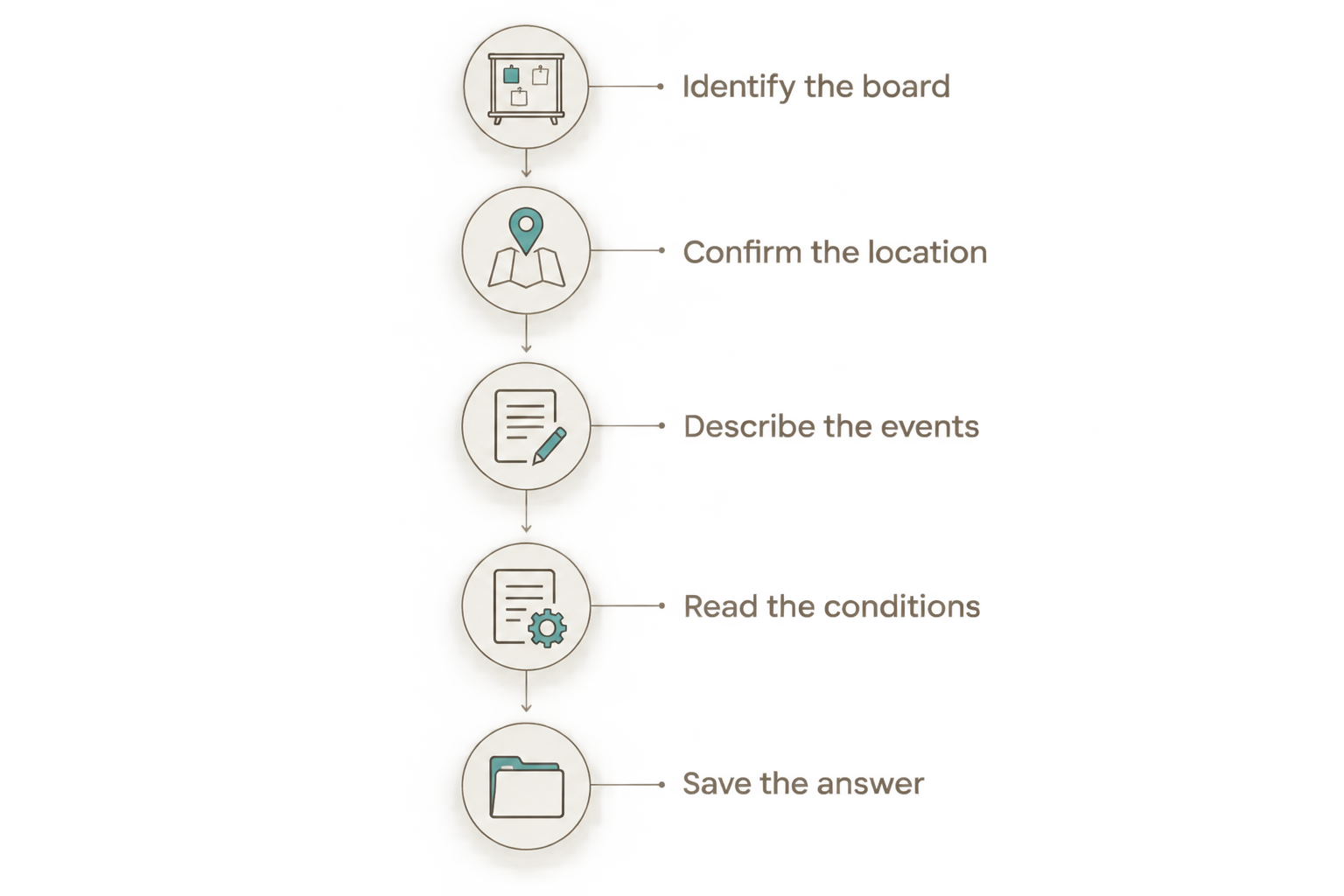
Work through these checks before your first drop-off. If you are organising everything from interstate or overseas, ask by email so the answer is easy to find when you arrive.
- Identify the board. Say whether it is your own board or a rental. Include its identifying details and ask whether accessories need separate confirmation.
- Confirm the location. Ask whether any cover applies to the actual rack, room or other area where your board will stay.
- Describe the events. Ask separately about theft, accidental damage and damage caused while someone handles the board.
- Read the conditions. Check exclusions, security requirements, claim limits, excess and reporting instructions in the applicable wording.
- Save the answer. Keep the agreement, insurance documents and written clarification with your board photos.
The point is not to collect a vague yes. It is to establish what happens to your particular board under your particular arrangement.
For a 2026 booking, ask for the documents that apply to that booking. A saved message from an earlier membership or a friend's arrangement is not confirmation of your own terms.
Why surfboard storage insurance varies
Insurance questions become clearer when you separate the details that need checking. Use these factors to guide your questions rather than assuming every storage arrangement works alike.
- Board ownership. Your own board and a rental board come with different agreements. Establish whose property it is and what responsibilities you have accepted.
- Storage location. Give the insurer or provider the actual storage arrangement. Do not assume wording about belongings at your accommodation also applies elsewhere.
- Type of incident. Theft, accidental damage and unexplained disappearance are different descriptions. Ask which events the wording covers.
- Security conditions. Check whether the documents require particular locks, restricted access or other precautions. Follow the stated conditions rather than guessing what is sufficient.
- Claim settlement. Read the applicable limit, excess and valuation basis. Confirm how an accepted claim would be assessed before relying on it.
- Dates and activities. Ask when cover starts and ends, and whether it applies only while the board is stored or also during handling and transport.
A clear answer about theft is not an answer about every kind of damage. Keep the questions separate, even when the booking itself feels wonderfully straightforward.
Can your own insurance cover a board stored near Bondi?
Your own insurance is relevant only if its wording covers your board in the proposed storage arrangement. Ask your insurer about the location, dates and intended use rather than assuming that personal belongings cover follows the board everywhere.
Best for: travellers checking an existing policy before arranging anything additional. The advantage is that you can establish whether cover you already hold addresses the situation. The limitation is that having a policy does not establish that this particular board or location qualifies.
For your 2026 trip, describe the setup plainly: you will leave a surfboard in shared storage near Bondi Beach, away from your accommodation. Explain whether you own or rent the board and whether it stays there overnight.
Request a written response pointing to the relevant wording. If the answer excludes this arrangement, you have a clear reason not to rely on that policy for stored-board protection.
What if you are visiting from overseas?
Ask your insurer about the Australian storage location and the activity you intend to do. Do not treat cover for luggage in transit as confirmation of cover for a board left in a separate storage facility.
Keep the insurer's contact details somewhere accessible without your usual travel paperwork. If something happens while you are away, you want the reporting process close at hand, not buried beneath flight confirmations.
What changes if you rent a surfboard?
A rental agreement sets out your responsibilities for someone else's board; a storage arrangement does not replace it. Check the rental terms before moving a hired board into separate storage or leaving it overnight.
Best for: visitors considering rental instead of bringing their own board. Renting lets you consider a different gear arrangement for your stay. The trade-off is that you still need to understand responsibility for loss, theft and damage; rental is not proof of insurance.
Ask whether the rental agreement permits your intended storage arrangement and what you must do if the board is damaged or missing. Keep those answers separate from any promises made by a storage provider.
A group surf plan needs the same care. Establish who holds the rental agreement and who is responsible for returning each board, rather than assuming the whole crew shares identical terms.
How does this fit a Bondi visit?
Bondi Surf Sisters is best for women seeking a Bondi surf community alongside board rental and storage. The offering includes secure board storage, group surf sessions, socials and surf trips; confirm which membership terms and inclusions suit your visit before making plans around them.
The appeal is more than finding somewhere to leave a board: you can look for a women's crew as well as a practical gear arrangement. The limitation for a visitor is that you must establish whether the membership works for your dates, with no assumption of short-stay terms or included insurance.
Ask Bondi Surf Sisters about your storage plans with your arrival and departure dates, whether you own or rent your board, and the insurance question spelled out. That gives the conversation something concrete to work with.
Check your Bondi storage plans
Ask which rental or storage membership suits your visit, and request the applicable insurance terms.
What should you record before dropping off your board?
Take clear photographs of your board before handover, including existing dings, repairs and identifying marks. Keep proof of ownership or the rental agreement, plus any documents relevant to the board's value.
These records help describe the board and its condition. They do not create insurance cover or guarantee that a claim will be accepted.
Use a simple 2026 trip folder for the paperwork:
- Board details: photographs, make and model where known, identifying marks and accessories.
- Agreement: the accepted storage terms and any rental agreement.
- Insurance: applicable wording and written clarification about the storage arrangement.
- Handover: messages or records confirming when and where you left the board.
- Incident contacts: the provider's and insurer's reporting instructions.
If your plans change, check the documents again. Moving the board elsewhere or extending your stay introduces details that your original question might not have addressed.
What should you do if your stored board is damaged or missing?
Report the incident promptly using the instructions in the storage agreement and any applicable insurance policy. Record what you found, when you found it and who you contacted, without guessing how the incident happened.
Photograph damage and keep relevant messages, receipts and reference details. Before arranging repairs or disposing of damaged equipment, ask the insurer or other party handling the matter what evidence they need.
For a rental board, contact the rental provider as well. Your reporting responsibilities under the rental agreement remain relevant even when the incident happened at a separate storage location.
FAQ
Does secure surfboard storage mean my board is insured?
No. Secure surfboard storage describes a storage arrangement, not proof of insurance. Ask for written confirmation that cover applies to your board and read the relevant conditions.
Is my surfboard covered by my travel insurance in Bondi?
Your travel insurance covers a stored surfboard only if the applicable wording includes that board and arrangement. Tell your insurer where it will be kept, whether it is owned or rented, and how you intend to use it.
What should I ask about surfboard storage insurance in 2026?
For a 2026 booking, ask whether customers' boards are covered for theft and accidental damage at the actual storage location. Request the current terms, exclusions, excess, limits and reporting instructions.
Does insurance for a stored board cover it while I am surfing?
Do not assume storage-related cover extends to surfing. Check where and when cover applies, including any separate conditions for handling, transport or use in the water.
Am I responsible if a rental surfboard disappears from storage?
Your responsibilities depend on the rental agreement and applicable terms. Contact the rental provider promptly and follow the reporting instructions rather than assuming the storage arrangement removes your obligations.
What photos should I take before storing my surfboard?
Take clear photos of the board, identifying marks, existing damage and accessories you are leaving. Keep them with your agreement and ownership or rental records; photos document condition but do not establish insurance cover.
Can I assume Bondi Surf Sisters storage includes board insurance?
No; confirm the applicable insurance terms directly before relying on cover. Ask specifically about your board, your dates and the events you want clarified.
One last thing
Ask where protection stops, not just where it starts. A board sitting on its rack, being carried to the beach and travelling with you are distinct situations to put to whoever is confirming cover.
For your 2026 Bondi stay, the useful outcome is simple: a storage arrangement that fits your visit and a written understanding of responsibility. Sort that before drop-off, then keep the paperwork handy while you make your beach plans.