
How to rinse and dry your board before shared surfboard storage
Prepare for shared surfboard storage: rinse off sand, dry in the shade and check your leash and bag. A practical care routine for women visiting Bondi.

Before shared surfboard storage, rinse your board with fresh water, gently remove sand, dry the surface with a clean towel and let remaining moisture dry in the shade before putting it away. Check the leash, fins and board bag too: a dry deck does not mean the whole setup is ready for an enclosed bag or shared rack.
- For shared surfboard storage, rinse away salt and sand, then towel-dry and finish drying in the shade.
- Keep wet leashes, sandy towels and damp board bags out of shared storage spaces.
- Bondi Surf Sisters combines a women's surf community with board rentals and secure storage in Bondi.
- Ask about the designated rinse area, drying arrangements and storage rules before your visit.
Why this matters
A little care after your paddle-out keeps sand and drips out of shared spaces. It also gives you a chance to spot damage before your board disappears into a bag.
If you are visiting Bondi in 2026, sort out the after-surf routine alongside your accommodation and board plans. Start with what to check before choosing secure surfboard storage, including where you can rinse and whether there is somewhere appropriate to finish drying.
Storage and drying are different jobs. Do not assume a rack, locker or board bag is designed to take freshly soaked gear.
How do you rinse and dry your board before shared surfboard storage?
Follow this sequence after surfing. Your board manufacturer's care instructions and the storage operator's rules take priority, especially for rental boards and unfamiliar materials.
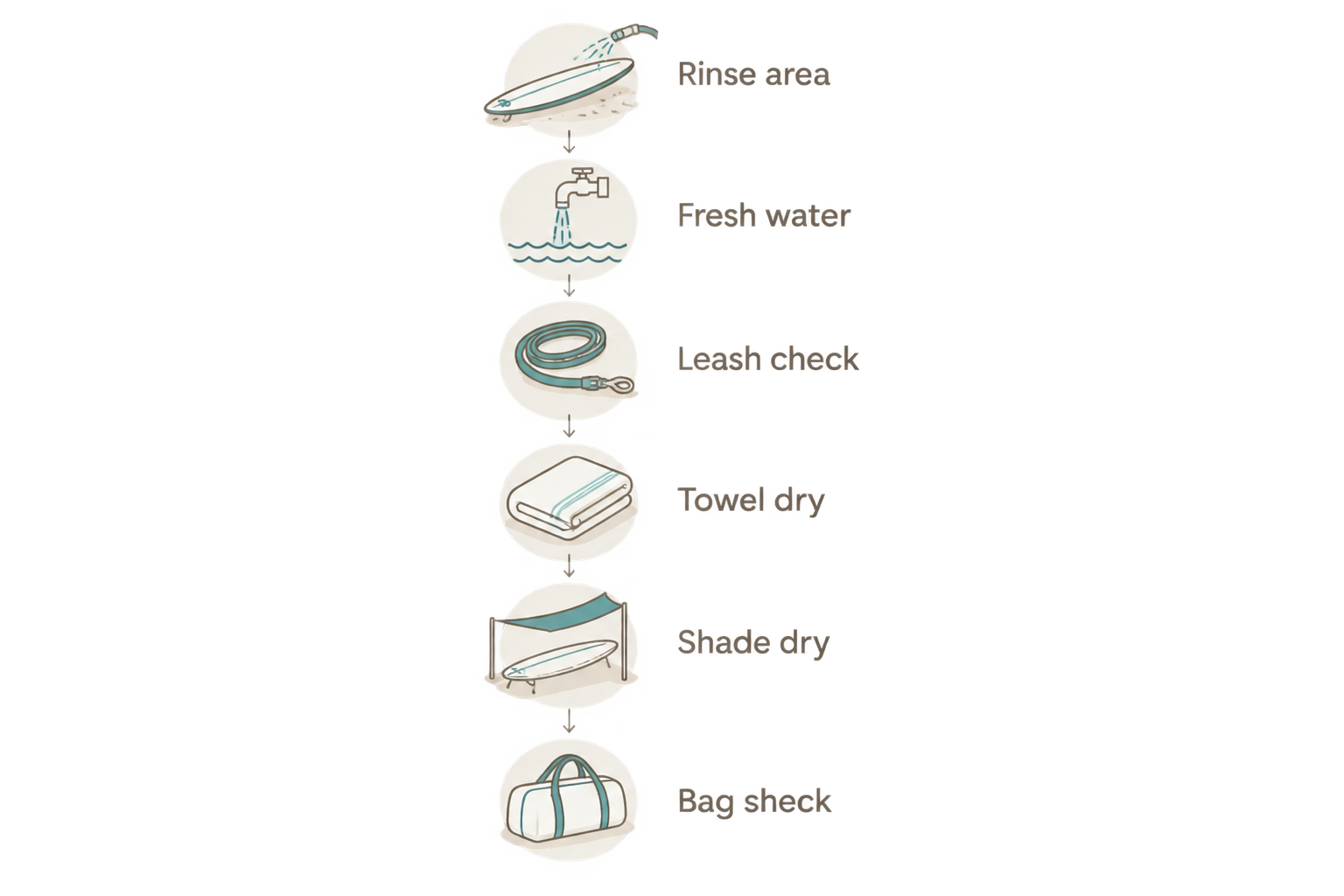
1. Find the designated rinse area
Use the place provided or approved for rinsing, rather than carrying a dripping board through the storage area. Keep paths and doorways clear while you get organised.
Before setting the board down, look for grit, sharp edges and hard surfaces that could mark it. Use a suitable board support if one is provided; do not balance the board on its fins or lean it somewhere it can slide.
If there is no rinse facility, ask the operator what to do. A beach shower is not automatically an approved board-washing station, and a shared storage membership does not automatically include washing facilities.
2. Rinse off loose sand with fresh water
Use a gentle flow of fresh water across the deck, rails and underside. Let the water carry loose grit away before touching those surfaces with a towel.
Pay attention to the nose, tail and areas around the fins, where sand can remain after the obvious patches have gone. Avoid blasting water into fittings, vents or damaged areas.
Rinse first; wipe second. Rubbing a sandy surface with a towel drags grit across the board instead of removing it cleanly.
3. Check the leash and accessible fittings
Rinse sand from the leash cord, cuff and accessible attachment areas. Open the cuff so you can rinse the surfaces that were wrapped around your ankle, then leave it open to dry.
Look around the fin bases and leash attachment without forcing anything apart. You do not need to turn every post-surf rinse into a full equipment strip-down; follow the manufacturer's maintenance instructions for removable parts.
Keep fingers clear of sharp fin edges. If a fitting looks loose or damaged, deal with that before the next surf rather than hiding it under a board cover.
4. Towel-dry without scrubbing
Use a clean, soft towel to blot or gently wipe away surface water. Give the rails and underside the same attention as the deck.
Do not scrub the waxed deck to make it look spotless. Routine drying is not wax removal, and a waxed surface will not feel like a freshly cleaned kitchen bench.
Keep your board towel separate from the towel you dropped on the sand. If the cloth picks up grit, stop and clean or replace it before carrying on.
5. Finish drying in a shaded, ventilated spot
Let remaining moisture dry somewhere shaded and suitable for supporting a board. Direct sun, a hot car and a heater are not drying shortcuts.
There is no universal drying time that suits every board, leash, bag and weather condition. Check the actual surfaces rather than working to an invented countdown.
Feel around the rails, tail and leash cuff, and look for droplets underneath. A soft-top surface or fabric cuff can still hold moisture after the smoother parts look dry.
6. Check the bag and put everything away
Make sure the inside of the board bag or sock is clean and dry before using it. Sliding a dry board into a damp cover simply puts the moisture back around it.
Carry the board to its assigned place and follow the storage setup's instructions. Keep the fins, leash and other gear within your space rather than extending into the next person's slot.
If something is still damp, ask where it belongs. Do not improvise a drying rail across shared racks or leave a wet leash bundled inside the bag.
Why your board's drying routine varies
Your 2026 holiday schedule can tell you when you need to leave the beach, but it cannot tell you when a board is dry. These practical differences change what needs attention:
- Surface material: textured foam and smooth hard surfaces do not feel or shed surface water in the same way. Follow the board's care instructions.
- Attached gear: a leash cuff or board sock adds wet fabric to the job, even when the board itself looks ready.
- Weather and airflow: damp, still conditions make a fixed drying deadline unreliable. Inspect the gear instead.
- Storage arrangement: an open rack and an enclosed bag are different environments. Confirm what the operator permits.
- Board condition: a crack, lifted surface or suspect fitting needs attention, not just another pass with a towel.
The answer is not to dry everything harder or leave it in hotter sun. Match the routine to the equipment and ask before storing anything that appears damaged.
Is towel-drying better than air-drying a surfboard?
Towel-drying and shaded air-drying do different jobs; use them together. A towel removes accessible surface water, while time in a suitable shaded spot lets remaining moisture dry.
| Method | Best for | Advantage | Limitation |
|---|---|---|---|
| Clean towel | Removing surface droplets after rinsing | Lets you dry the rails and underside deliberately | A sandy towel can drag grit; wiping misses damp fabric and recesses |
| Shaded air-drying | Finishing the board and attached gear | Avoids rubbing textured or waxed surfaces unnecessarily | Requires an appropriate space and does not follow a fixed timetable |
If you are packing for Bondi in 2026, choose a board-drying cloth for softness, cleanliness and whether you can dry it between uses. A towel that stays soggy in your day bag is not ready for the next board wipe.
When comparing affordable Turkish towels, keep the board towel separate from your sandy beach towel: the condition of the cloth matters more to this job than the style. Whatever you choose, shake out loose debris away from other people and wash the towel according to its care label.
Avoid using a towel as a cover over a board left in the sun. Shade should come from the location, not from wrapping wet gear around the board and hoping for the best.
What should you do if you are rushing back to your accommodation?
Build rinsing and drying into your surf plans rather than treating them as something to squeeze in after checkout. For a 2026 Bondi visit, ask about the routine before committing to a rental or storage membership.
You do not need a complicated itinerary. You need answers to a few practical questions:
- Where am I allowed to rinse the board?
- Where can it finish drying without blocking anyone?
- What should I do with a damp leash or bag?
- What condition does a rental board need to be returned in?
- Who should I tell if I notice damage?
Bondi Surf Sisters suits women who want board rentals and storage alongside a women's surf community in Bondi. The appeal is having a crew as well as somewhere for your gear; the practical check is whether the membership terms and arrangements suit your stay.
Bondi Surf Sisters offers rentals, secure board storage, group surf sessions, socials and surf trips. Confirm which arrangements and inclusions apply to the membership you are considering, rather than assuming a short visit comes with particular access or return terms.
Use the contact page to ask about your dates and the rinse-and-dry arrangements before planning around them. Come as you are, but arrive knowing where the wet stuff goes.
What if you spot a ding while rinsing?
A rinse is not a repair, and a dry-looking surface does not prove a damaged board is ready to store. If you see a crack, puncture, lifting surface or unusual soft area, stop treating it as routine cleaning.
Avoid directing more water at the suspect area. For a rental, tell the operator and follow their instructions; for your own board, seek advice from an appropriate repairer.
Do not pick at the damage, attempt an unfamiliar repair or assume a cover solves the problem. Keep the issue visible to whoever needs to assess it, and explain when you noticed it.
FAQ
Do I need to rinse my surfboard after every surf?
A fresh-water rinse after surfing removes salt residue and loose sand before storage. Follow the board manufacturer's care instructions and use the operator's designated rinse area.
Can I put a damp surfboard in a board bag?
Dry the board and the bag before closing the board away. If either is still damp, ask the storage operator where drying is permitted rather than sealing everything together.
How long should I leave my surfboard to dry?
There is no single drying time for every surfboard and set of conditions. Check the deck, underside, rails, leash cuff and bag instead of relying on a timer.
Should I remove surfboard wax before shared storage?
Routine rinsing and drying do not require stripping the wax. Follow the owner's or rental operator's instructions if wax removal is needed for maintenance or a longer break.
Can I dry my surfboard in direct sunlight?
Use a shaded, ventilated place rather than direct sunlight or artificial heat. Keep the board supported appropriately and follow its manufacturer's care guidance.
Do I need to remove my surfboard fins after every surf?
Do not assume the fins need removing after every session. Rinse accessible areas and follow the manufacturer's maintenance guidance; ask the operator before dismantling a rental board.
Can visitors use Bondi Surf Sisters board storage?
Ask Bondi Surf Sisters whether the current storage membership terms suit your visit. Confirm the membership period, access arrangements and inclusions before making plans around storage.
One last thing
Check the empty bag before checking the board off your list. A forgotten damp sock, sandy towel or wet leash inside it can undo an otherwise careful pack-away.
For your 2026 Bondi packing list, give board care its own small place: a clean drying cloth, a plan for wet gear and enough room in your schedule to put things away properly. Then you can head for that flat white without leaving a puddle for the next surfer.